by
CJ / December 17th, 2008
 For tourists, the safest, most reliable way to get from the airport to your hotel or apartment in Buenos Aires is to use the official airport taxis.
After you have passed through immigration and picked up your luggage, you will emerge in the airport greeting area. Look for a large booth that says Taxi Ezeiza. These are the official airport taxis.
You will pay in advance at the booth for your taxi. A trip from the airport to Palermo costs 90 pesos but this may vary depending on your destination. The cashier will give you a receipt. Wait beside the booth until a taxi driver comes and calls your number. On my last trip I waited about 20 minutes.
The drive from EZE to the city center takes about 50 minutes and passes through two toll booths. Tolls are included in the cost of the taxi.
Taxi drivers in Buenos Aires do not expect a tip.
On my last flight into EZE, an official handed out a notice to all arriving passengers that warned not to take taxis from people offering taxi services by voice. Apparently robberies have been committed by these unofficial taxi services.
Taxi Ezeiza offers a promotion for the return trip to the airport. The cost is 68 pesos if you book the taxi at least 3 hours in advance.
Here’s the Taxi Ezeiza website.
Another safe option is to take a remise. This is essentially a limo service. Several remise companies have booths in the airport.
Tags: EZE, Taxis
Posted in Need To Know |
by
CJ / December 17th, 2008
 The subway in Buenos Aires is called the Subte (SOOB-tay). Here’s what you need to know to use it.
First thing, you’ll need a map. You can find one online at the official Subte website.
Different Subte lines are identified with different letters. Line “D” is the line most often used by tourists since it runs through Palermo and Barrio Norte where many tourists stay, along Sante Fe, and into Microcentro.
Cost to use the Subte is 90 centavos per trip. That’s only about 25 cents (USD). You need to purchase a ticket at the ticket booth before going through the turnstiles to the platform. You can purchase a single trip (un viaje) card or a reusable multiple-trip card.
Place the Subtepass into the slot at the turnstile. The machine will read the magnetic stripe and pop the card out the slot at the top. Take the card, then go through the turnstile to the platform.
The machine stamps the date and time on the back of the pass. That way you will know how many trips remain on a multiple-trip card.
The Subte can be incredibly packed at rush hour. In summer it can be unbearably hot.
Trains run from about 5am until about 10:30 at night, depending on the line and whether it is a weekday or a weekend. A complete schedule is available at the Subte website.
Sometimes you might see a person walk through the train and hand everyone a little product like a book or pen, or place it on their lap. This is not a gift. He will come back in a minute to reclaim the product, or you can buy it from him.
Overall, the Subte is a safe and convenient way to move around the city. However robberies and pickpocketing do sometimes happen. But there’s no need to be paranoid. Use your common sense and you’ll be fine.
Tags: Subte
Posted in Need To Know |
by
CJ / December 17th, 2008
 Here’s a list of ten of my favorite things to do in Buenos Aires:
- Visit Recoleta Cemetery. While you’re there, check out the church next door (Nuestra Señora Del Pilar) and Recoleta Village.
- Eat a big, juicy steak and at a parilla restaurant. Argentine beef is delicious because the cows are grass fed.
- Take a tango class at La Viruta or any local milonga (a “milonga” is a place where people dance tango).
- Take the subte (subway). It costs only 90 centavos. The old, wood-paneled cars on the “A” line are particularly interesting.
- Go shopping on Florida street. Buy some shoes hand-made in Argentina. If it’s hot or rainy, step into Galerias Pacifico mall.
- See El Obelisco and the amazingly wide Avenida 9 de Julio. The Obelisk is the tower-like structure that resembles the Washington monument at the intersection of 9 de Julio and Corrientes.
- Eat empanadas. I suggest ham and cheese.
- See a soccer game or a polo match at El Campo Argentino de Polo in Palermo.
- Visit the Museo de Arte Latinoamericano de Buenos Aires (MALBA).
- Go to a boliche (nightclub) and stay out till 6am. Sahara Continent in Recoleta has a friendly atmosphere and plays a lot of pop and reggaeton.
Tags: La Viruta, MALBA, Obelisk, Recoleta Cemetery, Subte
Posted in Things To Do |
by
CJ / December 17th, 2008
 The Caesar Park Hotel calls itself “one of the top hotels in Buenos Aires.” While this is an elegant hotel it is also one step down from the true top hotels in the city such as Park Hyatt, Four Seasons, Alvear Palace and Hotel Faena.
I spent one night at Caesar Park this December. It’s well-located in the ritziest part of Recoleta on Posadas directly across from Patio Bullrich mall. My only complaint about the location is that there aren’t any fruit or vegetable stores or grocery stores nearby. There is, however, a very good wine store inside the mall.
Caesar Park embraces the European style and in the impressive lobby you’ll find a marble staircase, huge columns and a giant chandelier. Here’s a picture:
The rooms are luxurious but understated. There is no “wow” factor here.
I have the impression that Caesar Park thinks quite highly of itself and aims to be a top-flight hotel, though its finest days may have passed. This quote from their website sums it up:
“A sense of casual sophistication reigns with the hotel’s well-heeled guests, who are accustomed to life’s finer things and find them in abundance at the Caesar Park.”
You can often find rooms here for around $250 to $300 per night. The best hotels in the city charge $500 or more. One minor annoyance for me was the extra charge for wifi. At those kind of rates I want my internet connection included.
Note that there are two Caesar Park hotels in Buenos Aires. The other is called Caesar Park Silver Buenos Aires Obelisk.
Here’s a link to the Caesar Park website.
Tags: Caesar Park, Recoleta
Posted in Hotels |
by
CJ / December 17th, 2008
 When people ask me for tips on things to do while visiting Buenos Aires, Recoleta Cemetery is always my number one recommendation.
But visiting a cemetery sounds kind of boring, maybe even a little gruesome, right? Isn’t it just a bunch of dead people planted in the ground, and maybe a few pretty tombstones?
Not Recoleta Cemetery. It’s a fascinating place – more like a city for the deceased than a cemetery. There is no dirt here, not a grave in sight. Instead, the dearly departed reside in elaborate, expensive, above-ground mausoleums. And it’s quite a feeling to walk among them.
A number of famous people reside here. The most famous being the beloved Eva “Evita” Perón.
When you enter the cemetery you can pick up a map for a few pesos to help you locate tombs of interest. English and Spanish guided tours are also available. There is no charge to enter the cemetery. It’s free.
Before entering the cemetery you may wish to visit the church next door, Basilica Nuestra Señora Del Pilar. Tourists are welcome and the interior is incredibly ornate. Once inside, for a few pesos you may climb the stairs to the second level of the church where you can see a few items of historical religious significance and view the cemetery from above.
On weekends, there is an outdoor market next to the cemetery where vendors sell souvenirs and other items.
Also nearby is Recoleta Village.
Tags: Recoleta Cemetery
Posted in Things To Do |
by
CJ / December 17th, 2008
Salon Canning is a popular traditional milonga centrally located on Scalabrini Ortiz in Palermo. I recently checked out their Monday Night milonga with a couple of tango-dancing friends from Canada.
Like many milongas, tango classes are offered before the dance begins. On Mondays, the classes run from 7 to 11, but you can check out the current schedule here at the Milonga Parakultural website.
Entry costs about 15 pesos. Once inside, a host will seat you. The best tables, those immediately surrounding the dance floor, are reserved. You’d have to call ahead to book one of those tables. Otherwise, tables along the outer ring of the milonga are first come, first served.
The dance floor isn’t huge and on this night it was crowded. You won’t see “nuevo” dancing here, strictly elegant, closed-embrace tango.
On this night, a strange thing happened around 1 in the morning. Out of nowhere, the place started to fill up with young dancers, even a few tango instructors from DNI, and suddenly the dance floor was vibrant and alive with dancers aged from 18 to 80.
Someone at the table next to me said that the younger dancers arrive after they finish a practica at nearby Villa Malcolm.
I love the way the music and dance of tango bridges the generation gap and brings people together. I felt the heart of tango on this night.
Salon Canning is located at Scalabrini Ortiz 1331.
Tags: Salon Canning
Posted in Tango |
by
CJ / December 16th, 2008
 In Buenos Aires, you can change currency at banks or at currency exchange houses (casas de cambio). Look for the ones that post the exchange rates outside. Generally, currency exchange rates are excellent at these places and the spreads are quite tight.
You need to have your passport with you to change money. It’s a legal requirement in Argentina.
Many currency exchange houses are located on Florida in the main tourist and shopping zone. If you walk down Florida you will hear men yelling “¡cambio!” Some of these men will offer to take you to an exchange house where a passport is not required. I generally avoid these places and head straight for the first-tier banks or currency exchange houses. The rates are often as good, or nearly as good, and I see no advantage in doing a less-than-above-board transaction. That said, I have in the past changed money at no-passport-required exchange houses on Florida without incident.
Buenos Aires banks often close very early. Sometimes at 1pm, depending on the branch. Currency exchange houses offer longer hours.
One internet site that lists current average exchange rates in Buenos Aires is Dolarcito. The site is in Spanish but relatively easy to navigate. Another similar site is DolarHoy.
For your personal safety, don’t flash huge amounts of cash. I also don’t recommend exchanging thousands and thousands of dollars at one time, if it can be avoided. Why set yourself up as a target for robbery? It’s just common sense, right?
Tags: Currency Exchange
Posted in Need To Know |
by
CJ / December 16th, 2008
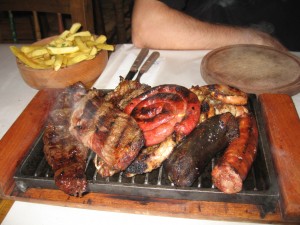 La Cholita is one of my favorite inexpensive restaurants in Buenos Aires and I consider it a real find. I discovered this place in 2007. An Argentine friend with a big appetite for meat and not a lot of money in his wallet recommended it to me. I’ve been going back regularly ever since.
There’s only one dish I order at La Cholita: la parillada completa. The menu says this dish serves two people, but I think four is more realistic. Maybe even six. The dish includes three types of sausages and all kinds of parts of the cow, most of which I have trouble identifying. Trust me, there is no way two people could possibly eat all this meat in one sitting.
La Cholita isn’t fine dining, but the food tastes good and the restaurant is popular. The price is right too. I recently ordered la parillada completa for two people and paid 48 pesos, including a side of fries. One year ago this same dish cost just 30 pesos. That should give you some idea of how high the inflation rate is in Argentina.
La Cholita is located at Rodriguez Pena 1165, just north of Santa Fe. The phone is 4815-4506.
Tags: La Cholita
Posted in Restaurants, Things To Do |
by
CJ / December 16th, 2008
 Many stores in Buenos Aires, particularly those in the larger malls like Patio Bullrich, Alto Palermo and Galerias Pacífico, participate in the Global Refund program for tax free shopping.
When you make a qualifying purchase of over 70 pesos at one these stores you can request a Global Refund Cheque. This entitles you (a non-Argentine citizen) to a rebate of the VAT (value added tax) when you leave Argentina.
Stores that participate in the Global Refund program will display a “Tax Free Shopping” sticker in the window. The refund applies only to products manufactured in Argentina.
The refund amount is the VAT minus an administration fee. The VAT rate in Argentina is 21% or 17.35% of the final price shown on the price tag. (In Argentina, the VAT is included in the sticker price, not added on later at the cash register.)
You can collect your refund at the airport when you are leaving Argentina. First, make sure you get your Global Refund Cheque stamped at customs BEFORE you pass through security and head to your departure gate. Then take your check to a Global Refund booth.
On my last trip to Buenos Aires I made the mistake of taking to my refund check to the booth near my departure gate. Since I didn’t get it stamped at customs before entering the secured area, I couldn’t claim my refund. That’s 39 pesos I will never see again.
More information at the Global Refund Argentina website.
Tags: Tax Free Shopping
Posted in Need To Know, Shopping |
by
CJ / December 16th, 2008
 There are several excellent shopping malls in Buenos Aires and Patio Bullrich is probably the most upscale of all of them.
The mall is located in Recoleta on Posadas, directly across from the Caesar Park Hotel. Many of the most expensive hotels in the city are nearby, including Alvear Palace and the Park Hyatt, both of which charge upwards of $500 per night.
If you are looking for designer labels, this is the place to shop. Stores include Armani Exchange, Christian Dior, Kenzo, Lacoste, Max Mara, Swarovski and Zara.
One store in particular that caught the attention of my girlfriend is Morph. It’s a specialty retailer that sells unique decorative and personal products. One product we purchased is something called “hidrogel”. These are tiny clear beads that expand to the size of marbles when you soak them in water. You can then use them in decorative flower vases.
Outside the mall at the Posada entrance you will often see very young children in the dirtiest of clothes opening doors for taxis that come and go with the hope of receiving a few monedas (coins).
Patio Bullrich also has a movie theater, cafes and restaurants.
Here’s a link to the Patio Bullrich website.
Tags: Patio Bullrich
Posted in Shopping |
 For tourists, the safest, most reliable way to get from the airport to your hotel or apartment in Buenos Aires is to use the official airport taxis.


